


The CactEye Chair Construction Process
- HOLLY NOWAK

- May 30, 2019
- 2 min read
The photo gallery below demonstrates in order the steps I took whilst constructing the chair.
Rather than a knitted cover that could be easily removed from the chair and resold etc, I decided that it was more time effective to work with and directly onto the chair itself. As this has become a conceptual piece of interior furniture there is less of a need for the cover to be , practical, removable, washable etc. This also solved some issues when working with the beading and pom pom / tinsel stuffing, they no longer needed to be considered and placed in a practical way, the focus could be on how people would interact and how effective it was visually.
I started by making 'Cacti tubes' out of plain cotton fabric. They were required for the back of the seat, the bottom and wing side panels, and the centre back and seat piece = 25 total.
Small tubes : 18
Big tubes : 7
They were then attached to the seat using velcro to avoid any sagging in the knit and to help the chair take the weight of the stuffed tubes, rather than it pulling on the knitted fabric.
The tubes were filled with bean bag beans, recycled stuffing from the chair itself, wadding, and any yarn wastage. By using different stuffings I hope the chair will offer a range of tactile surfaces, as well as creating a strange, uneven padding when sitting in the chair, making it feel quite odd to sit in.


Once the tubes were attached to the chair I started to individually hand sew each piece, sewing them together and around the natural and constructed shape of the chair. I worked my way around the outside of the chair, using a staple gun to tightly secure the knitted fabrics.


One big success for me during this process was that the knitted pieces fitted to the paper pattern pieces perfectly. I lacked confidence when it came to preparing the paper pattern pieces for the chair as it was an area I had little experience in. Translating those patterns to the knitted fabric was a completely new process to me, the variety of different yarns was a concern but the pieces couldn't have fitted together any better!


I then began working around the arms with a plain knitted fabric to act as a base before the cacti forest pieces (Partial knitting can leave small open holes within the fabric so having a base cover on the chairs and inner wings would prevent the natural red fabric of the chair showing through).


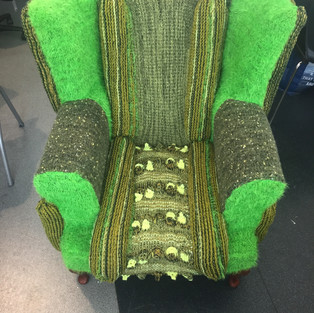


The centre pieces were added and any 3D cacti were stuffed with tinsel yarn in red and green, lime and green pompoms of different sizes and stuffing from the chair.


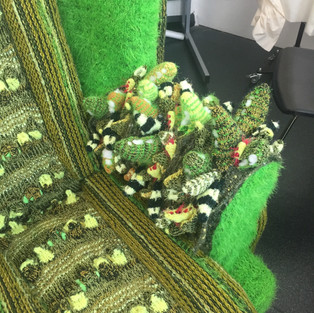


Tooth beads were added to some of the visual seams and monster eyes are placed randomly.
I had intended to knit a 3D version of The Hungry Ghost Eye however I haven't had the time to develop that yet.


Comments